Tuesday, May 22, 2007

Personal Storytelling as Therapy


Narrative may be an art form (as I've approached it here so far) , but it is very deeply wired into our human nature. It appears now that our self-told stories reveal a lot about us and may predict how well we will deal with what life brings. An item in the NYT today recounts research done by Dan P. McAdams (" The Redemptive Self"-2006) proves that indeed, stories matter.

As people tell their life stories, they may include universal forms: accidental beginnings, turning points, epiphanies, climaxes, defeats, and victories. As Americans we may include more culturally specific themes: atonement, conversion, emancipation, advancement, second chances, salvation and so forth. This is the stuff of Joseph Campbell ("Hero of A Thousand Faces") and the story-structuralists. It lies beneath the surface in dramatic structure and is exploited in the art of story-telling. What's new here is that story telling is not just a means to constructing our past, but how we interpret the present and shape our futures.

McAdams studied people who were in talking therapy, working through emotional trauma striving to effect some behavioral change. What he found was that those who were able to cast and replay their histories in the third-person were more likely to move ahead than those who continued to view past experiences only in a first-person. In a sense, the more succssful strategy is to make a movie of your life, and describe it as if from the outside. One one level this makes sense; getting some distance from the pain and trauma often does help us see things in perspective. That's why telling someone else (especially a relative stranger) about a difficult subject can feel so liberating. On another, it seems to veer toward a kind of dissociative state--the ultimate escape from pain being creation of an entirely new persona with no conscious awareness of the preceeding one.

This new research supports the work of Robert Fisher, whose "narrative paradigm" maintains that people are essentially storytellers and that history, biography, culture, and character determine what stories we take for truth. This model of the world is mediated by "narrative rationality"; the truth is known via the coherence and fidelity of our stories, which in turn, we are constantly re-adjusting to fit experience.

Wanna change? Re-write your back story.

Monday, March 26, 2007

The Communications Audit

I wrote up this piece for in-house use some years ago and reprised it here for WIW. Audits are a potentially powerful tool we corporate communciators too often overlook, perhaps because they are so often used polemically, or to get business. I drew heavily (though not I trust plagaristically) on PRSA white papers, as well as other online sources.

1. What is a communications audit?
Essentially, it’s a strategic estimate of any organization’s communications function. Audits look at structures (people, how they are linked, and what they do) as well as content. They look at how an organization spends money and profits(or loses) as a result of communication activity. According to a white paper from PRSA: “…..It is a complete analysis of an organization's communications, and effort to "take a picture" of communication needs, policies, practices and capabilities, and to uncover necessary data to allow management to make informed, rational decisions about future communications programs and resources. An audit should also lead to a series of recommendations.”

2. What is the scope of an audit?
The audit is distinguished from a project’s “creative” or “development” phase in that it is more comprehensive and refrains from defining executional questions. Instead, audits help define communications priorities and assign resources to address them. Audits can be very focused or very broad. “The scope can range from very specific attention to a single topic to a comprehensive review of an entire organization’s communications operations. Audits can measure the effectiveness of programs throughout an entire organization, in a single division or department, or within a specific employee group. It can examine communications on a particular subject or communications via individual media; it can uncover misunderstandings, information barriers and bottlenecks, as well as opportunities. It can help measure cost effectiveness, evaluate ongoing programs, confirm hunches, clarify questions, and, in some instances, reorient concepts among senior management”.

3. What does the communications audit provide?
An audit should be grounded in some objective material and be delivered from a detached point-of-view. Audits may use opinion surveys, statistical data, web traffic, independent observations or journal entries for empirical input. They should interpret data with rigorous analytical methods, such as those commonly accepted among professional management, finance, or the social sciences. An audit should… “provide meaningful information to members of management concerned with efficiency, credibility, and economy of their communications policies, practices, and programs. It also provides valuable data for developing or restructuring communications functions, guidelines, and budgets, as well as recommendations for action tailored to an organization's particular situation as uncovered by an analysis of the collected data.”

5. What subjects are covered in an audit?

• Communications philosophy
• Objectives and goals
• Current organization, tasking and staffing
• Existing communication programs and techniques
• Existing media used
• Personal communications
• Attitudes toward existing communications
• Needs and expectations
• Specific areas of concern


An Audit Method
1. Hold a planning meeting.
Determine the audit's scope and objectives. Identify question areas, plan an approach, and develop a schedule. Determine research questions and methodology (interviews, surveys, focus groups, statistical reports and analyses). Develop a budget and submit it for management approval.

2. Look for impact data.
What objective evidence for the effectiveness of current communications exists? Do we know how well current efforts are working? If not, we may need to design research to find out.

3. Talk to management.
Broad audits should first determine management's attitudes and beliefs about communications in general, as well as to pinpoint their particular views on the program, campaign or operations under study. More focused audits should find and tap key players’ background knowledge and experiences on the specific topic being audited. Management beliefs about communications’ relative effectiveness, value, cost and ROI are crucial to gathering resources for new communications initiatives.

4. Inventory and analyze existing communication material.
Gather samples of all existing communication vehicles and programs. Review them in light of the needs identified in the interviews and questionnaires. Map out the material against the desired communications objectives to identify strengths and weaknesses and gaps in the organization's current communications.

5. Conduct employee or end-user interviews.
Interviews are held with focus groups of employees (in the case of internal communications audits) or users (for external) who discuss the organization’s communications under the guidance of a consultant trained as a group facilitator. These sessions may probe issues and weaknesses identified in existing communications analyses or other impact data. They create soft data auditors can sift in order to find nuances, themes, attitudes and language that can be applied in later communications.

6. Gather additional impact data as required.
Survey data, among internal or external audiences may still be required. Auditors would draft and administer a questionnaire deriving items identified in earlier steps of the process.

7. Prepare a Final Report
Auditors gather all the data and write to the initial questions of the audit. They should make some determination of weaknesses and or gaps in current communications operations/campaigns/topics and arrive at a suggested strategy for correcting them in light of overall corporate objectives. The report should also make allocative recommendations, suggesting the appropriate staffing, tasking and media mix reflected in future communications pieces.

Friday, January 05, 2007

Walking Tour Guides


There are several outfits out there now doing audio narratives that have leapt from the museum-gallery trope into walking guides for actual neighborhoods and historic locations. I've found some interesting ideas at work in this evolving part of the audio creative spectrum. More will surely come, as iPods abound, production costs are low (you just need a digital recorder and some decent walking shoes) and one does not need to get releases to enter and talk about a location.

The firms iJourneys, Soundwalk, and Audissey seem prominent at this writing. iJouneys producer Elyse Weiner, who got a nice little write-up in the NYT last month, has created some concise and simply produced walking tours of the major tourist locations in Europe (the Forum in Rome, The west bank neighborhood in Paris, etc.) The .mp3 files done by AudisseyGuides are more "produced", even to the point of adding background music and the sounds of footsteps as you walk about the location. They've covered the touristy parts of six or so American cities. Titles by Soundwalk (also marketed on the web by Audible.com) are also highly produced, like movie soundtracks. They have covered 14 neighborhoods in NYC alone, and even have a Louvre-based talk using extensive clips from the DaVinci Code movie. As the user walks from one "station" to the next, they get the narration spoon-fed to them. Objects, views and stories are strung along the walk. I find the latter two product lines to be way over-produced, to my taste anyway. After all, if you are "there", you ought to be able to hear what's really going on around you, not some dopey music score.

These guides are typically downloaded right off the internet and retail for 14 to 20 dollars. Given the low production & distribution cost, this may be a decent way for well-traveled producers to make a buck. There are a zillion locations that could be aided by this technology; think of all the state parks and minor historic locations out there that could be opened up by informative or even dramatic narratives. Of course .mp3 players are inherently individual--at least for now.

The medium is well suited to the flaneur, but what about the touring couple or the small group? Later, we may see some way of cueing local .mp3 players to synch up from station to station on a tour, so a group of walkers could take it in together. In an earlier posting, I mused about place-sensitive media, triggered by GPS cues that could pace the narrative to the walker's random moves. Could get interesting.

This meme could find its way to industrial producers. Why not do an audio tour of the company's headquarters facility for new employees, or a more detailed tour of the production line to orient the workers to specifics of their new jobs?

Wednesday, December 13, 2006

The Most Intimate Medium

It is three o'clock in the morning. I'm laying awake, calculating the hours left before I might reasonably rise, and the options I have to get myself back to sleep. After laying there a few minutes, the detritus of the day running through my increasingly wakeful head, I reach for my iPod and dial up one of those wonderful Radiolab episodes I've been catching lately.

Within a few moments, I've got Jad Abumrad and Robert Krulwich talking, the stereo earbuds creating the illusion of sound emerging from the inside of my head. This episode happens to be about the deep neurology of moral choice; about the nature of morality itself, or at least the moral feelings we experience and where they might come from. It's a particularly thoughtful program, produced in a layered, conversational style with occasional sound effects to underscore the material.

Laying there, it occurs to me, this is perhaps the deepest penetration of something externally created one can experience...

Monday, September 04, 2006

Sawatsky on the interview

How should we interview? As a corporate producer, I've always been a soft-baller, learning to gently tease content out of my subjects, usually for the sake of promoting the company line. Unlike investigative journalists who need to perennially critical of their subject's responses, we corporate communicators don't get paid to look under the rug for scandal, or prompting our interview subjects into making iconoclastic revelations. The premise for quizzing our bosses, employees, customers, or consultants on camera, is an ostensibly friendly one (even though it could be considered an exploitive one as well).We're just happy with coherent statements. If we can get a genuine emotion, or a story, neatly told, we are elated.

But maybe we can learn a thing or two from our meat-eating cousins in the broadcast media. Canadian investigative reporter John Sawatsky thinks most journalists have got interviewing all wrong. It's not about the question, he claims, but the answer. In an age when politicos and corporate flacks get coaching on how to duck unwanted questions, side step negatives and spin their way along a desired "message track", Sawatsky has taken us back to the basics. We got away from that, he says, when interviewers became stars and tried to be part of the story themselves. He likes to harpoon show-off interviewers who try long-winded, stunt questions only to get a "yes" or "no" answer from the subject. Instead, he says, dump the "dialogue" and get back to interrogation.

Sawatsky's technique is akin to non-directive counseling. The point is to get to what the subject knows and feels, not to have a conversation in the tradional sense. Disciplined questions make for better and more illuminating answers, even when the relationship between the subject and interviewer is potentially hostile. The less interpretive and additive the questioning, the less opportunity you give to the respondent to spin. Sawatsky's gotten some street cred for his efforts. He's been hired by ESPN to train their reporters to work less at being "stars" themselves and harder at getting the story.

No problem there, we very humble corporate communicators are already all about answers, right? Don't we typically edit the final program entirely from subjects answers anyway, with our stuff winding up on the "cutting room floor"? What can we learn from this guy?

For one, I think we can learn to be more spirited in our questioning, and more genuinely curious. In the corporate world, we are conditioned not to ask too much; we learn not to dig for motive, seek clarification, or pull out subtleties in people's thinking. We tend to take statements at face value. Anything but conflict, hunh? Being a tad more investigative need not be a bad thing. Perhaps we can do that without being unfriendly, or even un-conversational.

Perhaps too, corporate communicators can be more than merely the trigger for prepared "comments". Maybe we can start getting our subjects to think and feel more spontaneously about the subject matter. The fact is that most people don't know what they are going to say about anything until they are asked. That's why the method of conversation can sometimes yield unexpected treasures of feeling and even a fresh insight, even if it is about the company's extended leave policy or the performance envelope of that new plane we are selling to the Chinese. So ask, and ask better.

Here's a quick Sawatsky primer on how to ask better questions:
  • Know your stuff. Prepare questions in advance. This does not mean knowing what the subject will say, it means stoking your curiosity.

  • Ask open-ended questions. Frame them to get facts and content back. Sawatsky urges us to be "inputters", saying as little as possible to get the subject to say as much as possible.

  • Don't stack up questions into two or three-parters. This is where preparedness helps. Ask one item at a time.

  • Don't grandstand your opinions or try to impress the subject with YOUR expertise. It's about her(him).

  • Keep the questions neutral in tone. Don't presume what your subject might say or how she might feel. The "friendly" interviewer can communicate warmth and curiousity
    without anticipating with or agreeing with everyhting the subject says. respectful interest is enough. Don't patronize the subject by "rewarding" good answers.

  • Transcribe your next interview and look it over. What's the ratio of your talk to the subjects? The steeper the ratio in the subject's favor the better.

    JEC

Tuesday, August 29, 2006

Shallow DOF

Lately I've noticed a lot of commercial and even journalistic photography using extremely shallow depth-of-field, in many cases, intentionally placing large areas of subject matter outside of crirical focus. It is a powerful technique for separating the figure and ground, thus controlling the attention of the audience. It reminds us that depth of field (DoF) has had a bumpy history.

To begin with, WE have shallow depth-of field imagers, called EYES. Our foveal (sharp image) area is only within about 4 degrees of the center of the visual field. It's up to our brains, and the rapidly-scanning saccadic movements of the eyes to put together the visual experience of a virtually unlimited DoF. In this regard, you might say our "stills" are shallow, but our "movies" are deep.

Of course, room-sized camera obscura, the grandaddies of all photography, rendered extremely deep-focus images, because image field was so huge compared to aperture. The problem with the camera obscura was that it had no way to capture the image (...this reminds us too that the camera obscura (hidden room) was a movie).

Once we learned how to capture a slice of visual time and feeze it chemically, we inherited shallow DoF again along with the technology. Before film, images were captured on large format plates. These early emulsions were relatively slow, so camera designs required either unbearably long exposure times or huge aperatures and huge lenses that could gather a lot of light fast. Perhaps the the most famous Daguerrotype of all showed about 1/4 inch of Abe Lincoln's nose in tight focus, with his ears way out there in blurryville. As film arrived in large medium formats, lens and emulsion technology made deeper DoF possible, when we wanted it.

The irony is that the "arty" look once imposed by the limitations of technology is hard to come by with today's super-deep focus digital cameras. These too, carry limitations imposed by the technology: the small size of the imaging area relative to aperture. Now folk seem to be adding the "old" look in post, with Photoshop.

One cute new DoF device for the digital still camera is the lensbabies device . It's been compared to the super-cheap Holga medium format camera, known for unpredictable accidents in camera, only without the "accident" part.

On the motion side, we are still a long way from the shallow DoF or "35 mm" look, mainly because of the imaging area available on a 1/3 inch chip. Even the top-end cameras like the Cine Alta and the Viper have only 2/3" imaging areas. HD movies, such as Collateral (2004) made the most of the deep focus and high light sensitivity capabilities of the digital camera.

But artists will still prefer the film-like, "soft" image aesthetic for many projects. We are already seeing a lot of DoF play in post-work, in movies as well as stills alluded to above. The upcoming Red camera's mysterium chip will boast an imaging field larger than that of a 35 mm film camera, so we may see the blurry background look arrive in digital movies at last.

Monday, June 19, 2006

The Compleat DV Single-Hander

Travels with me in a Pelican case:
Panasonic DVX 100A Camcorder
Sennheiser Wireless Audio Kit (base and remote body mic)
Batteries, charger and AC adapter
Digital Still Camera, two lenses
Remote control
Hard-wired lavalier for quick interviews


Fed-Ex or Xtra Baggage:
Sticks with fluid head
Soft key light (Lowell)
Stand for light
Extra lamps, AA batteries
Monopod
Extension cord
Blank tape stock
External LCD monitor
Second soft key or baby
Second light stand
Flex fill

Saturday, June 10, 2006

Singlehanding It

I decided I would finally do it: after 20 or so years of running field interviews as a director/writer/producer, I would go out on a shoot, a serious assignment, shooting the video entirely on my own.

This may not seem like a big deal to soldiers in the army of free-lance producers out there who never do it any other way. But for one from a corporate culture and grounded in the notion of specialization, going it alone is counter-intuitive.

I did so with some trepidation. Even though I've shot enough of my own, home video with the same gear (Panasonic DVX100), taking the plunge on a REAL job meant over-riding a little voice in my head that said, "Better watch it, you'll screw up. You'll forget to roll, or you'll get flustered and record over an entire tape, or you'll get so caught up in the technicalities that you'll be flat for the interview.", and so on.

Customarily, I go out alone and meet up with a local crew we book through an agency. They are carefully vetted; competent and well-equipped. Since we started using services like Crews Control over a decade ago, I have seldom come back with anything but usable video under my arm. There is a downside to this very convenient kind of production however—the constantly shifting camera/audio specs along with subtle differences in style, framing, and lighting to be found among video professionals. More subtle is the cost of one’s having to direct and monitor a perennially “new” crew to make sure you sure getting something approaching what you want. This distracts you from your focus on the talent and the content, which should be the center focus for you.

So for a while, I’ve wanted to just do it myself, and this seemed to be the time to give it a try. I faced a two-city, three-day tour to collect a series of sit-down interviews for a number of new video projects. All were "low risk" situations, where, if I got less than stellar material, no deadlines would be missed, and no client would be there to watch me crash and burn. Easy-to-shoot DV would be an acceptable medium for these projects, and we already owned the necessary gear.

The big plus was saving over three thousand dollars of crew fees and rentals. But a deeper reason was my own need for freedom. After years of working with video that was all over the map in terms of lighting, composition and recording parameters, I wanted to start imposing a more consistent style on the work. Shooting solo, I reasoned I'd be directly engaged in seeing and making the content, not having to direct a stranger. It was the auteur in me, wanting to get out, I guess. My own production manger discouraged me, diplomatically, pointing out the extra burden on me, avoiding saying something like: “you are not a pro shooter and you should stick to your knitting”, yet meaning just that.

This is moving against the grain, but I’ve long since lost any remaining desire to be surrounded by underlings. In many situations in our industry it is necessary to collaborate and delegate, of course. But for many processes, especially artistic ones, I’d begun to feel that people can get in the way. I was ready, after years of depending on others, to wander off and go it alone.

The question was, of course, could I deliver the goods? After many years of still photography experience, and watching countless video operators set up and shoot, I figured knew what to look for in terms of proper exposure, white-balance, and composition. I knew how to light for a portrait with a strong key and a fill source. I knew how to place a lavalier mic and set audio levels.

Actually, I had been assembling a solo capability for a while. Over the past two years, I had acquired a great little pro-sumer camera, the Panasonic DVX 100, and had picked up a Sennheiser wireless mic system designed just for it. In pro shooters’ hands, we’d already gotten usable video with this unit. With its large, flip-out viewfinder and an array of auto functions and presets, the DVX 100 goes a long way to de-mystify the process of getting “professional” video. With the technical issues thus minimized and pushed to the background, it seemed to me I could reasonably expect myself to light and set a shot, roll the camera, and be free from that point forward to concentrate almost entirely on content.

So off I have gone on my first solo. Notwithstanding a few lapses on the basics, like entirely forgetting to hit “record’ for one extended (and wonderful) take on my second major interview, and a few near-misses on starting up the remote mic, I can honestly report the results have been good.

Most gratifying has been the release from that awkward process of managing a third party to “see” the shot for me. Even in performing something as simple as a seated interview, I did not realize until now how much energy goes into directing others—especially a pick-up crew. In the beginning, you have to give as much or more attention getting to know your operator and sound man as you do your subject. Just getting names right takes some effort at first. Common courtesy always seems to require a little bit of “who have you worked with?, or “what kind of camera is that?” kind of smalltalk with a fellow professional, even when time with a subject may be squeezed. During the interview, you still have to communicate with crew to compose, tweak, “roll” and “cut”, and so forth. While you may not be touching all the technics directly, you still have to manage a social setting apart from the interview itself.

Taking the management of the tools upon myself was going to use up some attention of course. I figured part of this could be addressed by building in some set-up time alone, with just the gear to unpack and lights to set, before the subject arrived. I did this on my first solo, and enjoyed the luxury of attending entirely to my tools for an hour beforehand, and methodically wrapping out only after the subject was gone. Over time, I can see how I might become so familiar with the gear and setup protocols that they become transparent, as they have for me with still camera.

I’ve found a kind of intimacy can be achieved by working alone with a subject. Being interviewed with a crew present may be reassuring to some subjects, but it’s also true that having others watching and (presumably) listening also creates an “audience” for both of us to play to. While I’ve experienced the boost that a crew/audience can give to performers playing scripted or ensemble performances, in the interview setting at least, I’ve found my self-awareness increased. The connection with the subject suffers to that extent. This new approach may help move us back to something closer to a one-on-one conversation with the subject.

Portrait painters typically work alone with their subjects in the intimacy of the studio, their paints and brushes having become an automatic extension of their faculty for seeing. Perhaps the ideal setting for the video interviewer is the same, with the electronics and optics having been subordinated during a private conversation, only later to become a public performance.

Going solo, at least for the interview, has worked. I now know I can save thousands of dollars, most of which will go to the bottom line, and some of which can be invested in an improved single-hand kit. But it has helped me discover something even bigger: the value of self-reliance. There may be slips and misses along the way from here, but I doubt that I will ever feel anything but compromised by having to shoot with a crew again. The way for me now seems clear: to fully master the technics and continue to build a style.

Saturday, January 28, 2006

e-Learning rules


Thanks in large part to our colleague Sara Jalali, here is what we had been using as a "bible" for our writers and developers for e-learning:

1. Text should be the standard delivery format. (People have to read the stuff.) A manuscript should always be accompanied by a breakdown of core concepts and processes to be learned.

2. Writing style should be friendly and suited to the small screen. Write sparely for scan-reading, but don't over use bullets. Training should be fun, engaging, not boring. Use "voice" and the vernacular wherever possible.

3. Visual media (Illustrations/diagrams/animations and action video clips) should be employed to support and enhance text. Visuals are crucial instructional aids and not just pretty pictures. Illustrations can provide examples and modeling of key behaviors. “Story” clips can convey key emotional content.

4. We should design backwards from the desired outcomes -- The goal of all training is to improve performance. Each course should have clear organizational goals stated as outcomes. Then learning objectives should be written in behavioral terms (such as "plan a den meeting using all seven steps," rather than "know the parts of a den meeting.") The objectives should be stated at the beginning of the course and/or the beginning of each section or module and reviewed at the end (Safe Swim). Everything in the course should be closely related to learning objectives, especially all interactions and test questions.

5. Adopt a "semi-linear" course structure to provide learner choices and personalize the experience. Offer a clear path that the user will follow if he/she just uses the "next" button to progress through the course. But also offer a menu the learner can use to step off the path to find information quickly for reference.

6. We should provide interactions -- Each course should include frequent, meaningful interactions that require at least a little thought. Interactions should not be fancy "next" buttons. Much of the learning that takes place in the course happens through interactions -- as in the old adage, people remember most what they do. But interactions should respect the intelligence of adult learners and should help them practice and apply crucial information. They should reflect real-world context and help learners approximate what they will need to do in their jobs. Interactions should use visual analogies and illustrations whenever possible rather than just text (see Visual Analogies and Illustrations below).

7. We should use Stories wherever possible. A storyline can run throughout the course to tie all the elements together, provides real-world context and modeling, while adding interest. A story brings the information out of the abstract world of principles and procedures and allows users to identify with characters in situations they can relate to.

- A variant of this idea is the use of scenarios one of our earlier courses starts out with a scenario of Scouts on a hike who jump into a river to swim and cool off. The user is asked to identify the most important principles that are being violated before those principles are presented. This allows the user to make a prediction, think about what he/she is going to learn, and creates a sense of suspense about the course material. At the end of the course, the same scenario can be revisited with a different outcome. A scenario at the beginning of a course is a good way to draw users in immediately.

-Another variant of this is the "Guiding Character -- Safe Swim uses a tongue-in-cheek guiding character called Qualified Supervisor. He guides the user through the course and fits with the light tone of the course. A guiding character also serves to pull the user into the course and adds interest.

8. Use Humor -- The Safe Swim course uses light humor throughout and a cartoon visual style, although the course is clearly aimed at adults. This combination allows for a fun course experience and helps with retention while respecting adult learners.

9. Use visual analogies -- Both VFS and Safe Swim use visual analogies, such as the kayak scene in VFS to illustrate Venturing Methods, and the desk scene with steps of organizing a Venturing crew. Safe Swim uses a sandwich metaphor for the safety principles. These visual analogies are used both to present information and then in exercises and games. Visual analogies help with retention and add interest to what can otherwise be dry lists of principles or policies.

10. Provide performance support tools -- If it is feasible and applicable, it's great to provide useful tools for users, such as the PCI survey tool and the program planning calendar in VFS. This not only helps users practice crucial skills within the course but gives them tools that they can take away and use to help them later in their jobs.

Following my exposure to Dave Allen in his very fine ASTD certification for E-learning, I think I have a better understanding of e-learning. Here's what I'm playing around with now:

E-learning is not about presentations, but about interactions.
These are media objects that are responsive, that change when acted upon and can be played with by the user open-endedly. An interaction is not an assertion, but a problem. It relates to a didactic concept called "active learning" or "problem-based learning" commonly used in more progressive elementary/secondary education. The defining characteristics of PBL are:
(a) learning is driven by open-ended problems,
(b) students work in small collaborative groups, and
(c) 'teachers' per se are not required, as the process places them backstage as 'facilitators' of learning. In e-learning, the role of the teacher is the design of the object.
Advocates of PBL claim it can be used to enhance content knowledge and foster the development of communication, problem-solving, and self-directed learning skill. This is all cousin to constructivism which views learning as a process in which one actively constructs or builds new ideas or concepts based upon current and past knowledge. Constructivist learning is a very personal endeavor, whereby internalized concepts, rules, and general principles may consequently be applied in a practical real-world context.

Ultimately, learning is not a relpication of an idea, but a personal and novel effort to cope with the universe. According to Jerome Bruner and other constructivists, the teacher acts as a facilitator who encourages students to discover principles for themselves and to construct knowledge by working to solve realistic problems, usually in collaboration with others. This collaboration is also known as knowledge construction as a social process. Collaboration is what the more progressive schools (and all successful creative endeavors) do. In E-learning, however, at least as we define it today we are still stuck with the single-user computer interface paradigm which leaves the user alone with the learning object. As we develop haptic and gestural interfaces for the PC, we may see collaboration finally arrive on the scene for e-learning too.

Tuesday, January 10, 2006

Documentary Rules

Two basic rules come flooding back into my memory, both from my mentor on film-making, Tom Doades:

1. Know your footage!
He was right. Don't just set aside time for the shoot---but an equal amount of time after the shoot to review and take notes on the footage. If you shoot 3 days, take 3 days in post-production just to know what you have--only then will something begin to take shape organically.

2. Mess with it a lot before settling on a cutting plan (edit).
There are many tropes. Here's one very usable one:
Build a piece with Interrogative structure: Find the implicit question. Set it as a hook. Open with that big question based on an impressive fact, or incident; set up the rest with questions you'd want answered, then knock them down with actual answers, embodied in actualities.


A few more specific notes from this HDV project:

When shooting on a long form project, make sure to use sequential time code hours for every roll across locations and shooters. HDV has problems with this, or at least today's cameras do.

16 x 9 is a beautiful format, but it can't be crowded. When acquiring in HD but using in SD, closeups can be, um, scary. Too much!

Sunday, January 08, 2006

Understanding Genres


We encounter genre throughout the arts. It pops up in everything from Elvis' velvet paintings, to the cross-dressing conceits Shakespeare used in his comedies, to the action-scene-every seven-minutes formula currently dominating Hollywood movies.

One wonders why.

A guess: Fundamentally, humans like patterns. For us, some level of predictability is good, even though we readily tire of exact repetition. Maybe pattern-finding worked, somewhere in the archaic struggle for survival. Our evolving brains glommed on to marginally efficient sorting routines for any environmental clues leading to safe food, likely sex, or just another day away of escape from being eaten .

Art, another survival strategy, probably balanced novelty with the familiar from the get-go. Evolutionary theorists say that art (singing, dancing, making interesting smears on the cave wall) was a sexual strategy, a means of differentiating oneself from the others. You got the girls (or the guys) by getting a little bit more attention. But pure novelty was never enough. There had to be, in any artistic gesture, enough that was familiar for the others in the clan to know what you were up to. "Ok, what Grogg is doing over there is a song, not just some random warbling", or "I get it, he's
showing us what that mammoth looked like, not just making muddy streaks on the wall".

So it was that our brains evolved with a taste for art. And so it is that were are all on a sliding scale of just how much novelty we can tolerate. The lovers of Elvis paintings or re-runs of Gilligan's Island are only marginally different from the avant-garde. We have to know "it's a painting", or "it's a comedy" before we can appreciate the stuff that's different in it.

Genre boils down to rules.

Rule-finding, and rule-bending then, become the deliberate pastimes of the producer.

The rule/pattern finding below is related to the "media map", but is more contemporary and focuses on current mass media tropes (for instance, medieval mystery plays are not included, but "Lost" is).

Movies
Dramas
Comedy
Documentary
Essay
(see article)

Television
Multipart Documenary (This American Life)
Set-Chat (The Tonight Show) var.: Sofa Chat(Good Morning Am)
Sketch comedy (SNL)
Newsroom/Anchor Desk/standup field report
Music Video
Drama (sub-genres: limbo studio, 3-wall, cinematic, on location)
Variety
Ernie Kovacs (unique)
2-Camera Sitcom(Honeymooners)
3-Camera Sitcom (All In The Family)
"Diary" driven drama
Self-contained drama
(ascendant genres)
Multi-Threaded Drama
Procedural
Hybrid
Pulpit
1 on 1 interview (Charlie Rose)
Spectator Sport(sub generes/tropes: the stadium booth, the locker room intrerview, the sideline standup, play-by-play and color announcers, etc.)
Set Game
Staged sport (Gong Show, Fear Factor)
Reality (Real Life, Survivor)

Audio/Radio

Standalone audio
Radio Documentary (see film documentary)
Studio Chat (Stern)
Interview w/POV (Open Source)
Panel
Game
Call-in
Variety
Essay (ThisAmLfe)

Challenge to corporate producers: why not make use of more than just a few of these to package our messages and gain audience attention? ....the "Jeopardy" set game to teach employees about benefit options?....the "Tonight" show set to interview the big boss? This does not mean making a self-conscious knock-off of an existing show, nor should it mean trying to meet the creative finish or production values of a broadcast original. The tropes work for some deeper reason. Understanding the working device and applying it, is where we as the producers come in. Our job is to engage latent audience curiosity to make use of the talent and messages available. As we rake among the leaves of successful and unsuccessful mass media vehicles, we can find prototypes to adapt to our purposes.

Sunday, December 25, 2005

Digtial Storytelling and Narrative

Two interesting leads to follow here. One is Dana Atchley (Nextexit.com), the other is Stephen Denning. One was a performer, one is a theorist.

Atchley believed that "brand" is conveyed in stories. he made a good living going around to corporate meetings and retreats, stimulating creative behavior and innovation. His show "Next Exit," was a blend of performance art, memoir, stand-up comedy, and documentary film. He did a sort of trunk show, using a video campfire on a huge screen and a headset microphone, weaving his live narrative around digital movies crafted from 8MM home movies, stills, and video clips. Interacting with the audience, he selected 12 to 18 stories for the evening.

Atchley, who passed away recently, was a showman. It was about him. The real meme-carrier here may be Stephen Denning. His book, The Springboard: How Storytelling Ignites Action in Knowledge-Era Organizations, and his daylong workshop, Storytelling in Organizations, revolve around his experience in international development, but can be appled to any organization wishing to expedite the transfer of knowledge within its boundaries. The notion is that abstract ideas and Powerpoints often fail to ignite people's imaginations. Story is what moves people. Get the right one, tell it succinctly, and you can start a revolution.

One wonders how useful this simple idea could be on an organizational or company website: a good story, powerfully told, either in text or mediated form. The right story can communicate loads about a brand--even be the brand. The question of whether the story is true or not is of course going to be a factor in its power, but even myths presented as fiction may be quite moving.

Thursday, December 01, 2005

Attention, please

Here's one of those seminal ideas (can there be more than 12 in a given zeitgeist?). We owe this to Michael Goldhaber and his bravura article in the online journal First Tuesday.

Prop. 1.: Classical economics is about stuff: commodities such as food, housing, air, water, labor--anything that there is only so much of, and that we need. The wanting of things and the striving to get them is the basis of value, classically speaking.

Prop 2.: Economics is the study of how we humans exercise choice under conditions of scarcity.

Prop. 3.: In the emerging information economy, knowledge is the basis of value. But here, a flip-flop occurs. Not only is knowledge unlimited (the "space" of the entire knowledge accessible on the i-net now googles in at about 8 billion pages, and counting ) but the cost of getting to to it, unlike the "stuff" of classic economics, is rapidly approaching zero.

Prop. 4.: The kicker. What is limited in this new economy is attention. We have only so much time, so much bandwidth. This changes the basis of value. Those who get a lot of attention are what we call "stars". They get a lot of money. Politicians and business people who get a lot of attention for their proposals and their ideas acquire power.

This seems pretty self-evident to anyone who ever passed a year in the eighth grade. Before we had cars or cool pads of our own, and everybody's physical wealth was limited to their physical selves and their clothes, attention was the coin of the realm. The popular kids got the most valentines, and ran for class president, and got to be captain of the basketball team.

The great ages of the material; stone, bronze, iron, and steel are rolling away, soon to replaced by hydrogen and then, perhaps pure thought alone. The coming century may redefine the very notion of value, basing it less on consumption of stuff, more on the differences among competing parties ability to exploit the vast amount of knowledge out there and convert it into something others will pay attention to.

Maybe it won't be "...who dies with the most toys wins", but "...who gets the most eyeballs along the way".

We need to be about attention. If we are, the long term odds for profesional communicators will be looking good.

Tuesday, November 29, 2005

Understanding Flickr

My first flickr picture.

Yikes.

I can't quite grasp it yet, but this appears to be an astonishing increase in personal capability: I can post, share, store, organize and tag anything I have in my stock photo files, and I can determine the level of sharing I wish to do with the asset. I can even sell it. The cooler part is this: I can acquire anything anyone else has shared.

This is apparently an example of what some call "web 2.0".
It is manifestly about collaboration, and to some extent, it is about trust.

Monday, November 28, 2005

Long-tail economics

The tech bloggers are warning us that what's coming is a set of new web apps and services that have "long-tail economics" at the heart of their business models. Wired magazine recently described the long tail phenomenon. Essentially, it's a lot of small publishers getting relatively few hits as opposed to a few biggies dominating the publishing space. "(This is ) an entirely new economic model for the media and entertainment industries, one that is just beginning to show its power. Unlimited selection is revealing truths about what consumers want and how they want to get it in service after service, from DVDs at Netflix to music videos on Yahoo! Launch to songs in the iTunes Music Store and Rhapsody. People are going deep into the catalog, down the long, long list of available titles, far past what's available at Blockbuster Video, Tower Records, and Barnes & Noble."

So much for the mainstream. More and more, we will find it easy to drill down to that particular content that interests us--whether it be music, videos, books, or simply the thoughts and writings of other people anywhere on the planet.

Monday, November 21, 2005

More on the Flat World

For corporate media managers to ask themselves:

Are we learning to use the new tools of collaboration?
(Friedman lists them, where are we at on the tools that have shaped the flat world: shared data, workflow, blogs, wikis, supply chain mangement, wireless and remote)

Do we fully appreciate outsourcing?
(Have we made outsourcing a bugaboo?...are we so busy resisting it that we are missing the opportunity to do a better job, to evolve our jobs? Conversely, should we be in-sourcing to capitalize on our strengths and assets?)

Are we properly specialized? (related to the above, involves digging into our selves, x-raying ourselves personally, departmentally, and corprately to see who we are and what we do)

Are we building trust?

(Say what you will about technology and efficiency, business is done in a social context. Trust is a keystone of economic behavior; how do we build it here, how remotely?)

Do we run through Kubler-Ross' 5 stages of grief: denial, anger, bargaining, depression and acceptance?

Tuesday, November 15, 2005

A Media Map


This is a project that could take a lot of time: mapping the various media forms as they have evolved over the ages, from ancient Greek drama and poetry to online computer games. It could also call for a real scholar, which I am not.

Why? Because we who work in the media professionally must continually reevaluate our media choices as the clutter of mediated content continues to grow. Attention is the ultimate bandwidth issue; our ability to get and hold the user's attention will require us to exploit all the art forms humans have ever created to exhort, delight, entertain, and educate.

In the wholly unreadable chart above, I've speculated that all forms of communication art emerge from two fundamental human behaviors: speech and gesture. The arrows suggest the evolution of the forms from the classic seven arts of the Greeks forward. Scott McCloud's books on the art of comics gave me a lot of good ideas. This is just a start. A really complete map would be scalable (like Google Earth) and have hyperlinks to articles and more links to books and examples of the forms themselves.

CMMA Short Bit

Fall CMMA Short Bit presentation:

As we focus on our creative inspirations during this conference, let me share some of mine, at least from the province of books.

I’m not going to talk about fiction. That’s a whole thing in itself. For me, there have been a handful of non-fiction books that I have come back to again and again in my adult life and have deeply influenced my work as a media professional. I can’t share a lifetime of reading in 5 to seven minutes, so I’ll quickly mention just five books.

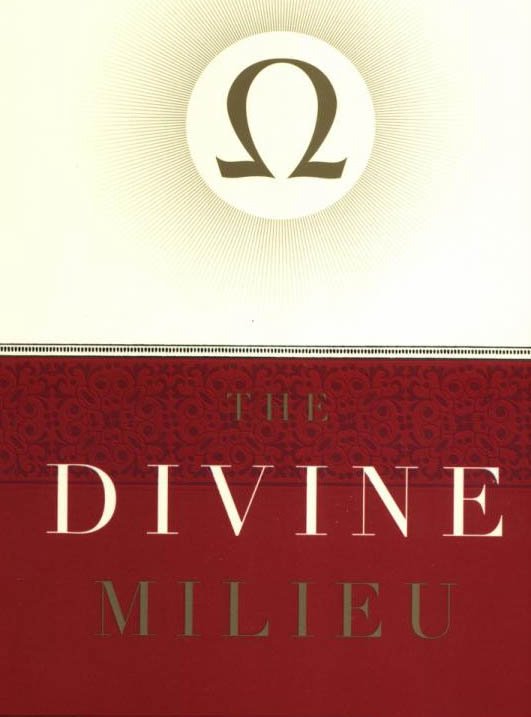
One I read when I was 19, and a very serious young man. The book was The Divine Milieu by French Jesuit Philosopher and evolutionist Theilhard Chardin. He had a vision, very impractical, very “out there” --not be realized for a thousand years, that human consciousness had evolved out of the minerals of the universe, arising in life forms and flowering in the human as a spiritual sense. He believed it was Man’s destiny to merge eventually into a collective cosmic awareness he called the “noosphere”.

This book was a milestone for me -- my first encounter with a really big idea, and it was so exciting. Even though I’ve wandered away from this kind of religious speculation, a fascination and hunger to find the big ideas hiding in the mundane has stayed with me ever since.

If only Pierre Chardin could have lived fifty more years to see the world wide web, to see a billion people able to connect at the speed of light and catch the movie trailer for Wedding Crashers in Chinese! But seriously, the web does present major implications for the human family, even if all the things it promises may not come without pain.

One of those books I’ve just finished reading is The World is Flat, by L Thomas Friedman. We’ve heard our keynote speaker allude to it, and I know a few of you here have read it too. Friedman modestly subtitles it “a brief history of the 21st century”. Friedman, like Chardin, chases a globalization theme. He gives us a pretty darned gripping account of the technological and economic revolution that has been going on while most of us were distracted with 9/11 and what followed.

He’s telling the story that is affecting every one of us in this room! I have been assaulting everyone I know telling them they MUST read this book and was delighted to see it pop up right here at CMMA--- written into the theme of our next CMMA Spring Professional Development Conference that Bill Marriot and others will be hosting in North Carolina next year.

Another big book for me was The Language of the New Media by Lev Manovich. This is not an easy book, but it is a very rich one. I keep going back to it and finding insights into what we try to do with things like websites and multimedia. Manovich teaches media theory at UCLA. One of his big bombs is that the new interactive media we see playing out on the web are more than HTML versions of books or cinema. The new media are databases, and users are not passive audiences but active users. We will keep their attention only if we understand and use the new rules --building database worlds for users to explore.

I’m still learning from this guy.

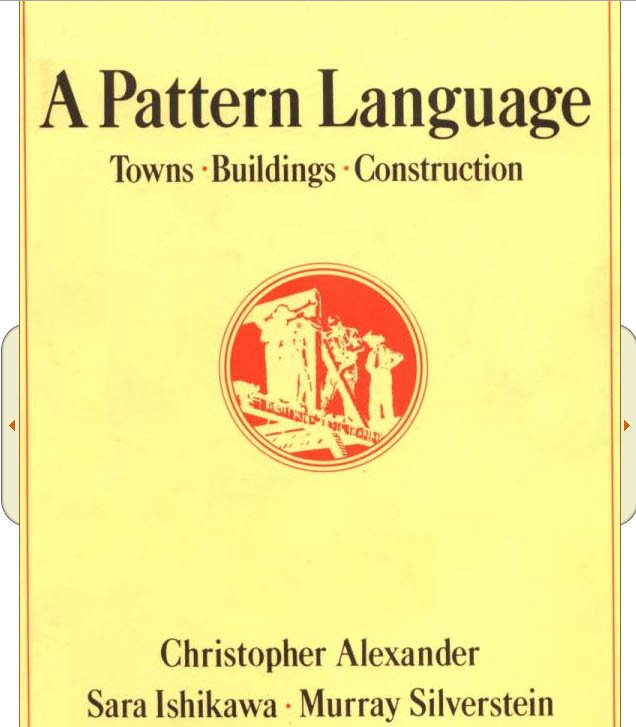
I am an armchair architect. One of those books that’s affected my life and my work is Pattern Language by Christopher Alexander, and others.

My copy is well-thumbed.

A Pattern Language lays out the elements of building, prescribing general rules of how things work best, from the perfect positioning of a reading chair next to a sunny window, to the principle determining how high counters should be in a workplace.

Christopher says he found these classic patterns hidden in the vernacular; the past two thousand years of human building. He lays out about 300 of these patterns. He shows how they can be used by anyone—not just professional architects and builders—to make a fit and beautiful habitation.

Alexander’s big idea about patterns has popped up the art of writing computer code—and the open source movement—the guys who brought us Linux and APACHE server and PERL and free Blogger! Its all about discovering and applying those most “fitting and beautiful” patterns. It occurred to me some years ago that another pattern language might exist for media forms just as well as buildings did in Alexander’s classic book.

A big project to do someday, perhaps.

I have come to think that there are patterns hidden in media for us to figure out and use to make fitting and beautiful media things. Right now I’m really on fire about the pattern language hidden in Podcasting. Last summer I started looking at audio blogs and their subscription-based cousins, Podcasts, for work. The idea is produce short "radio" pieces with corporate training content and make them available for download, or subscription via RSS.

This my current passion! My fire has been lit for the year!! I’m all on fire about the new medium of the 21st century! Radio! I am going to get my clients excited because production costs will be significantly lower than what we spend on even a very modest video project.

Radio breaks out of the box called “screentime”, and once the user subscribes to a show, new installments are downloaded automatically and saved on their hard drives. It’s time-shifted radio. You listen when and where you want.

One last book to mention. I’m slaking my hunger for big ideas about media right now by following up my reading of Understanding Comics by Scout McCloud with his Reinventing Comics. He shows us that comics is a serious medium, worthy of our study, not just as it relates to print, but online too. Big ideas here---lots of implications for our kind of work.

I’m out of time, but I’ll post this little list and my comments on my weblog if you are interested. As you see me walking around please feel free to ask me about my podcast pilot, or pattern languages or Chardin, if you really have time to kill! Thanks.

Wednesday, August 31, 2005

Carpooling

Carpooling is based on the insight that we have all those cars zooming around out there going everywhere 24/7, most with just one occupant. The unused capacity is mind-boggling. What to do? Carpooling is starting to go high tech, facilitated by use of computers, GPS devices, cellphones and the internet. Both free and commercial applications have popped up in Europe and the West Coast of the US. Newly jacked-up gas prices and the possibilitiy of supply line problems following Katrina may make it more popular in a lot of communities soon.

The high tech solution is a classic exchange. A database is accessed on the web by a limited membership group. Participants post and confirm "lift offers" and "lift requests", then users just confirm their trades and meet up on the parking lot. Basic services could be offered on a daily basis. It could get more formal of course. The addition of cellphones and GPS devices could aid in scheduling lifts ever closer to real-time. Setting one of these up would be a great service for IT and web development shops to offer their companies. The software essentials are close at hand, and we could look like the heroes we really are.

Some links:

http://en.wikipedia.org/wiki/Carpool

From Wikipedia:
Advantages

* As most cars are designed for 5 people but only occupied by 1, car pooling has great potential improve the capacity of congested traffic corridors in cities, with minimal investment in infrastructure.

* Higher occupancy rates also can reduce consumption of oil thereby reducing corresponding political and economic risks, reduce emissions of greenhouse gases, reduce common pollution, and save considerable expenses from gasoline, oil, tires, auto depreciation, tolls, parking, and in some cases insurance.

* Carpools may provide social connections in an increasingly disconnected society

Disadvantages

* Drivers carry the additional burden of potential legal action from passengers in case of an accident.

* Car pooling combines the disadvantages of public transport (lack of privacy, fixed timetables) with the disadvantages of the automobile (low safety, high fuel consumption, high cost of labour). Well designed, dedicated BRT systems have proven a faster and cheaper alternative to car pooling in big cities.

Others offer a tool for carpooling using GPS and a commercial DB:
http://www.greenride.com/

Free carpool tools and DB:
http://www.erideshare.com

...and for group set up:
http://www.erideshare.com/newgroup.htm

Here's a commercial service that uses cellphone technology to perform real-time, "dynamic" pooling:
http://www.ecolane.com/services/carpool/index.html

Saturday, August 13, 2005

Podcasts, Two

Yesterday may have been historic in the annals of communications. Under court order, the city of New York opened part of its archive of records from Sept. 11, 2001. The New York Times today released a huge cache of of oral histories, dispatchers' tapes and phone logs in PDF and MP3 formats..."so vast that they took up 23 compact discs.", according to the Times.

We don't know to what extent this particular release will be accessed by the public, but clearly, it transcends the volume and complexity of what is even possible in a real-time stream of broadcast radio and TV. How will people use this stuff?

Like the whole podcasting phenomenon, this kind of publishing promises to further break down the singularity of the broadcast model. It points away from the realm of fleeting events toward something enduring and the searchable. More and more, our role as communicators may shift from preparing a single strand of narrative to presenting content as database.

If it re-defines the author, it may redefine "audience" to something like a "quirience" (to coin a word); the active set of users who build personal meaning out of a rich medium of information. In this new realm, both the content preparers and the quirience will need to live by the same set of rules; a mutually understood grammar of presentation, access and re-construction. The closest approximation I can think of right now is the set of rules that underlie the online gaming experience.

Unlike a movie one sits and watches for two hours flat, a contemporary online or multimedia game can deliver dozens of hours of "play time". Gaming has radically altered our notions of media use, presentation time and attention span. What game designers and their users have come to share is a whole set of uber-rules about game use.

Maybe the would-be datacasters, like today's Times', and their quirience, will need to arrive at the same set of rules. Maybe we already have them. What somebody needs to do is figure out what they are and explicate them.